
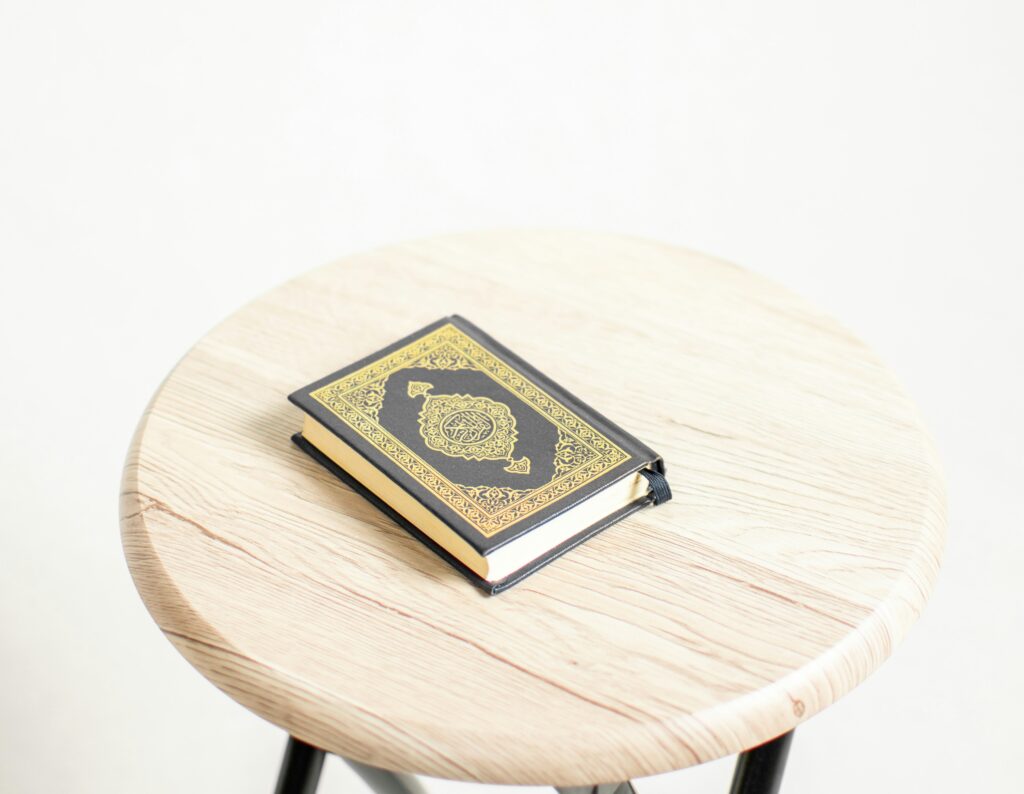
Is the Qur’an for your shelves or for your self? For many, Ramadan is the month we dust off our Mushaf, pick up where we left off a year ago, and embark on a race to the finish line. Yet, even as the pages turn, a quiet distance often remains between our hearts and the Revelation. As we approach the second half of Ramadan, we stand at a spiritual crossroads. Beyond the “Ramadan Rush” of finishing the Book, the real triumph is how far the Qur’an actually gets into you. It is time to ponder and evaluate our ibadah to truly see the beauty within God’s Revelations.
As the crescent of Ramadan rises, hearts naturally gravitate back toward the Book of Allah. Yet, this return is often tinged with the realization of how far we have drifted during the year, treating the Revelation as a seasonal guest rather than a permanent resident. Allah reminds us in Surah Al-Baqarah (2:185): “Ramaḍan is the month in which the Quran was revealed as a guide for humanity with clear proofs of guidance and the decisive authority…”
The Qur’an is far more than a text to be recited with perfect tajweed or rhythmic tarannum; it is a comprehensive life manual for mankind to navigate our actions and direct our thoughts toward what is pleasing to Allah. As a timeless source of wisdom, it serves as a living guidance that allows every sincere reader to find personal relevance in its verses—and surely you will find ease in this effort.
The 17th of Ramadan commemorates Nuzul Al-Quran, marking the first revelation to Prophet Muhammad ﷺ in the Cave of Hira’. While scholars discuss different dates, many view the 17th as the moment the first five verses of Surah Al-Alaq—emphasizing reading and seeking knowledge—descended upon the Prophet’s heart. To appreciate this guidance, we reflect on the three profound stages of its descent:
Understanding these stages reminds us that the Qur’an is an “honored” message, sent in truth to settle upon your heart, prepare you in observing the deen, and remind you of the true essence of being human.
The revelation of the Qur’an was not just a historical transmission; it was the start of a transformation for the soul. In Surah Al-Isra’ (17:82), Allah mentions: “We send down the Quran as a healing and mercy for the believers…”. Allah’s revelations revive humankind through:
We live in an era where “busyness” is a badge of honor. This cultural tide has led to Hajr al-Qur’an—the forsaking of the Qur’an. This is often a slow, digital drift where the noise of the world crowds out the “Voice” of the Creator.
Three Categories of People with Respect to the Quran
In a hadith Narrated by Abu Musa Asy’ari, The Prophet ﷺ compared guidance and knowledge to rain falling on different types of land:
Imam Ahmed (rahimahullaah) said: “People are in need of knowledge more than their need for food and drink… because knowledge is needed as much as the number of breaths”. The analogies showed from the hadith demonstrated how the Quran is seen as the main source for the revival of our life as well as others and the heart or “land” may dry out without the shower of Quranic teachings. So, which land are we living on?
While we battle digital distractions, the people of Gaza show us what true connection looks like. Amidst rubble, their hearts remain fixed on Allah’s verses. Gaza has one of the largest Qur’an memorization populations per capita. The Islamic Waqf reported nearly 40,000 students learning and memorizing the Qur’an since 2006.
Zakariya Alzemly, a professor in Gaza, states: “The Quran gives us comfort. We’re living in bad conditions, under pressure. The Quran teaches us patience”. It is their personal relationship with the Qur’an that provides the courage to stay the course. There are more examples to reflect on from the lives of the Prophet’s Sahabahs and our pious predecessors who practiced the Quran. But relating it back to our current times, it will be a shame for us to make excuses in seeking Allah’s guidance.Such resilience is admirable and woe to ourselves for neglecting the favors that pleases Allah over the favours of the people. Then which of your Lord’s favours will you both deny?
Ramadan is the best month to reset. Whether through Talaqqi (reading), Tadabbur (pondering), or Tazakkur (reminder), we must find a way to interact with the Words of Allah.
How do we move from “recitation for reward” to “recitation for revival”?
A simple yet profound practice that you can try is to recite and reflect upon the last two verses of Surah al-Baqarah before sleep. The Prophet (ﷺ) said they are “sufficient” for the one who reads them at night—providing protection, spiritual elevation, and a fortress against the “devils” of distraction. When we connect the Qur’an’s meaning and benefits as guided by the Sunnah, we find the enlightenment necessary to truly revive it in our daily lives.
The Prophet (ﷺ) was a man of presence who reflected deeply in the stillness of the night. As this Ramadan reaches its peak, ask yourself: Will the Mushaf return to the shelf? Or will we finally awaken our hearts to the guidance meant to be our constant pulse?
The Qur’an cannot be changed by anyone, but it can change anyone. This Ramadan, do not let the revelation be a temporary guest in your home. Let it be the light that remains long after the moon of Shawwal appears, for the one who the Qur’an reaches its’ heart is as if Allah is conversing with you. This Ramadan, let the Qur’an change you.