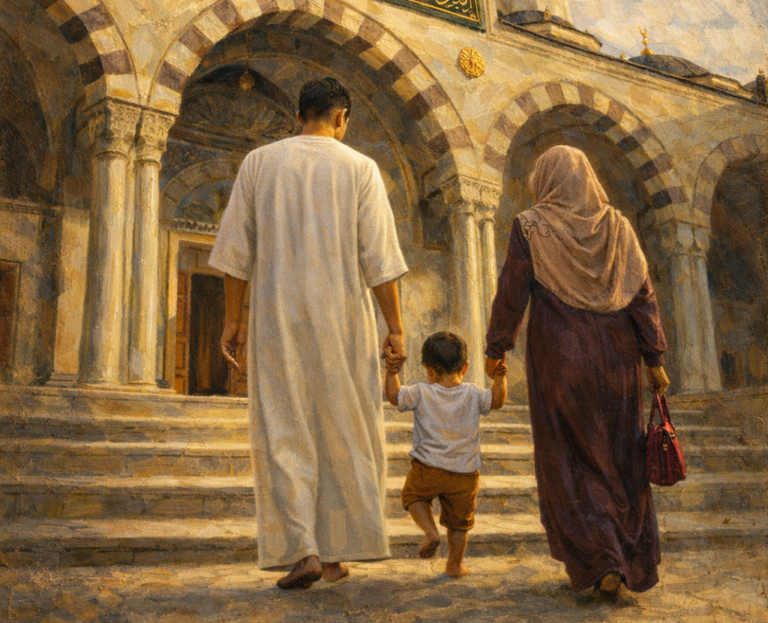


Many of us feel as if time is chasing us, biting at our heels as the years slip by. We lie awake at night thinking of the “what ifs” of our future: finances, career, children, ageing parents, our own health, and a bucket list that never seems to shrink. This restlessness is not just stress; it is a sign that the soul knows time is limited, and that what fills it truly matters.
For a Muslim, parenting sits right at the heart of this anxiety, because a child is not just “our responsibility” in the casual sense, but an Amanah – a sacred trust from Allah (Mohd Hasrul Shuhari, 2019). Children, like wealth, are described in the Qur’an as both a blessing and a test; how we deal with them will be questioned on a Day when hours and pay slips no longer matter, but intentions and relationships do.
In our tradition, once a person reaches maturity, they become mukallaf – charged by Allah with obligations: prayer, character, contracts, and, for many, marriage and parenthood. This taklif can feel heavy, but scholars like Imam al-Ghazali explain that the weight itself is a form of honour, because Allah does not burden beasts of the field with moral responsibility; He gives that to human beings whom He wishes to raise (see usul al-fiqh on mukallaf/taklif; al-Ghazali, Ihya’ ‘Ulum al-Din, Books on ethics/child-rearing).
Parenthood, seen through this lens, is both a mihnah and minḥah. It is a mihnah (a test) because it stretches patience, drains energy, and exposes every weakness in the heart. Yet it is also a minhah (a gift) because the very same sleepless nights, difficult choices, and sacrifices become ladders to Allah when carried with sabr and ikhlas. Scholars describe every drop of sweat, every frustrated tear, every hidden worry for a child’s deen as a potential seed of reward in the hereafter. Allah says in the Qur’an:
ٱلْمَالُ وَٱلْبَنُونَ زِينَةُ ٱلْحَيَوٰةِ ٱلدُّنْيَا ۖ وَٱلْبَٰقِيَٰتُ ٱلصَّٰلِحَٰتُ خَيْرٌ عِندَ رَبِّكَ ثَوَابًا وَخَيْرٌ أَمَلًا
“Wealth and children are the adornment of the life of this world. But the good righteous deeds that last, are better with your Lord for reward and better for hope.” (Surah Al-Kahf ayat 46, n.d.)
The Prophet ﷺ said that each of us is a shepherd and will be asked about our flock (Tough Love in Islamic Parenting (Is It Really Islamic?), 2025); the father is a shepherd over the people of his house, and the mother is a shepherd over the home of her husband and over her children. This hadith is often quoted, but in a busy, urban life, it needs unpacking. A shepherd does not lead his flock via emails and voice notes. He walks among them. He knows which animal limps, which one is skittish, and which one tends to wander. Similarly, being a parent in Islam is not just about paying bills and enforcing rules from a distance; it is about knowing the inner states of the family members entrusted to you. Yet parents are exhausted. Commutes, deadlines, messages, and constant notifications can turn the home into a corridor between screens and sleep. Burnout becomes the silent enemy of shepherding.
Instead of seeing burnout only as failure, let us try to treat it as a sign that our load and our methods need rebalancing. Even Musa عليه السلام had a long period of hard, simple work as a shepherd, but he did that work with ihsan, with a heart still connected to Allah, and it became training for a prophetic mission, not a distraction from it. The lesson is not merely to “work less” – which is not realistic for many – but to work with a more conscious heart, clear intention, and firmer boundaries, so that the shepherd is still present enough to recognise his flock.
There is a well-attested report of a young Jewish boy who used to serve the Prophet ﷺ and fell gravely ill.
وعن أنس رضي الله عنه قال: كان غلام يهودي يخدم النبي صلى الله عليه وسلمى الله عليه وسلم الله عليه وسلم فمرض فأتاه النبي صلى الله عليه وسلم الله عليه وسلم الله عليه وسلم يعوده، فقعد عند رأسه فقال له: “أسلم” فنظر إلي أبيه وهو عنده؟ فقال: أطع أبا القاسم، فأسلم، فخرج النبي صلى الله عليه وسلمى الله عليه وسلم الله عليه وسلم وهو يقول: “الحمد لله الذي أنقذه من النار” ((رواه البخاري)).
A young Jewish boy who was in the service of the Prophet (ﷺ) fell ill. The Prophet (ﷺ) went to visit him. He sat down by his head and said to him, “Embrace Islam.” The little boy looked at his father who was sitting beside him. He said: “Obey Abul-Qasim (i.e., the Messenger of Allah (ﷺ)).” So he embraced Islam and the Prophet (ﷺ) stepped out saying, “Praise be to Allah Who has saved him from Hell-fire.” (Al-Bukhari)
In this hadith, we learned that the Prophet ﷺ went to visit him, sat by his head, and gently invited him to Islam; the boy looked to his father for permission, and when his father told him to obey “Abu al‑Qasim,” he uttered the shahadah. The Prophet ﷺ left saying words of praise to Allah for saving the boy from the Fire, because he knew that guidance is purely a gift from Allah; a gift that arrived through years of quiet contact, patience, and good character. The boy had watched the Prophet ﷺ up close as a servant, seen his honesty and mercy, and felt his concern when the Prophet ﷺ came personally to his bedside; taken together, these hidden acts of service became the unseen bridge by which Allah brought the boy to faith, showing how a life of consistent, unnoticed goodness can end in immense, hidden rank with Allah.
Parents live in that same domain of hidden Ihsan. The world rarely sees the mother who drags herself out of bed to comfort a child while carrying her own unanswered worries, or the father who absorbs humiliations at work to keep a halal income flowing to the family. These actions do not trend online, but the angels record them, and Allah, Ash‑Shakur (The Appreciative), multiplies them. The reward for fulfilling the Amanah of parenting appears in many forms: sometimes as tranquil homes, sometimes as righteous children who make dua’, sometimes as an unexplained ease in worship or resilience in hardship. Parents should look for these subtle gifts as signs that their unseen sacrifices are not forgotten.
Imam al-Ghazali famously likens the child to a pure, uncut jewel (On the Raising of Children- Imam al- Ghazali (ks), n.d.): if shaped in the right way, it becomes a beautiful, beneficial ornament; if neglected, it can be ruined. He details several dimensions of this shaping (ON THE RAISING OF CHILDREN, n.d.):
These insights speak directly to the work-life dilemma. If most of a child’s waking hours are shaped by school, media, and peers, then the limited hours with parents become incredibly precious (Ramadhanul Ikhsan, 2025). A painful reality for many families is that there may truly be only one free day in the week; Saturday, for instance, when everyone is together and relatively unhurried. The Syariah does not ignore such constraints; what it speaks about instead is taufiq and barakah, i.e alignment with Allah’s will, and blessing that makes a little go a very long way.
To turn a small window into something weighty on the scales:
1. Anchor it with worship.
Begin the day with a shared Fajr experience: praying together, reciting even a few verses, and making a short, heartfelt dua’ that Allah places love and guidance in the home. This aligns the heart before the day’s activities start.
2. Choose presence over expense.
A walk in a nearby park, cooking a meal together, visiting grandparents, or attending a short class together can all be deeply bonding. Many of the salaf and scholars lived and raised righteous children with very little by way of material entertainment (Playing with your Children, 2015); their wealth was in intentional companionship and mutual remembrance of Allah.
3. Ask deep, simple questions.
Ask your child: “What made you happy this week?” “Was there anything that made you feel small or scared?” Ask your spouse: “What is something you miss doing that used to make your heart light?” These questions may feel strange at first, especially in cultures where emotional language is rare, but within the safety of a family, this strangeness is actually a sign that a new, healthier pattern is being born.
Every effort is an act of ibadah if done seeking Allah’s pleasure. The niyyah transforms the mundane into worship, and worship, by its nature, attracts barakah. In the end, children are not obstacles to success; they are one of the greatest means through which Allah grants true success. Promotions, titles, and possessions will one day cease to matter, but the dua’ of a righteous child and the echoes of a good upbringing can continue to elevate a parent’s rank long after burial. When parents re-centre this amanah with intention, tawakkul, and thoughtful effort -placing trust in Allah after striving-, the relentless world softens with barakah. Work and family become wings, not weights, carrying the heart home to Allah, as the righteous pray:
“Our Lord! Grant unto us wives and offspring who will be the comfort of our eyes, and give us (the grace) to lead the righteous.” (Surah Al-Furqan ayat 74, n.d.)