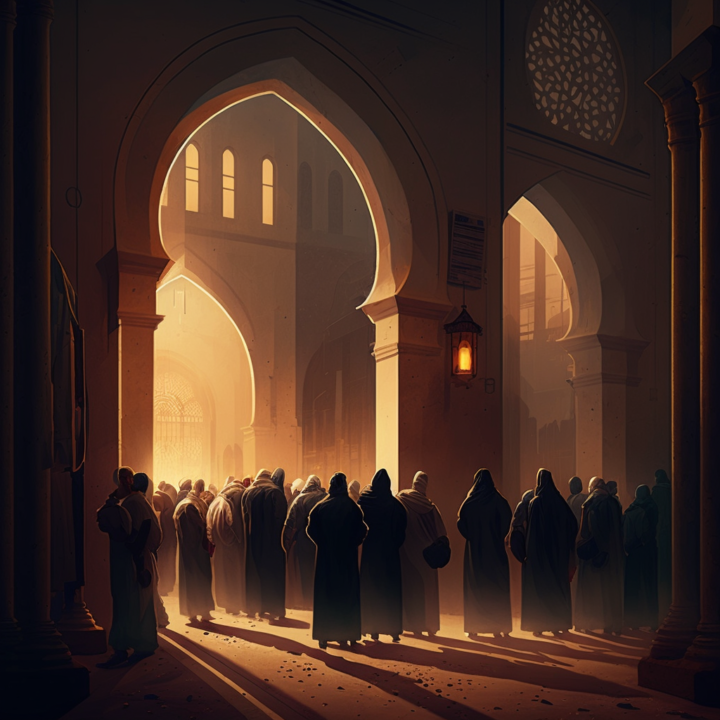


Isra’ and Mi’raj refer to a journey undertaken by Prophet Muhammad ﷺ in a single night, by the command of Allah ﷻ. The Qur’an affirms the event without elaboration, framing it not as spectacle, but as a showing of signs. Surah al-Isra’ opens not with wonder, but with purpose: “that We might show him of Our signs” (17:1). The night was pedagogical before it was miraculous. Its significance lies less in what was witnessed, and more in what was established.
The central outcome of Isra’ and Mi’raj was the obligation of ṣalāh. Prayer is the only pillar of Islam legislated beyond the earth. It was not prescribed gradually, nor delivered through intermediaries on the ground. It was received directly in the Divine presence.
Its initial prescription of fifty daily prayers, later reduced to five while retaining the reward, establishes a defining principle: obligation in Islam is inseparable from mercy. The reduction came through the Prophet’s ﷺ repeated return to his Lord—an enacted lesson in du’a, persistence, and the mercy embedded in divine legislation. Musa’s ﷺ counsel to return was not interference, but recognition born of experience with a struggling people.
Ṣalāh was not given to burden the believer, but to anchor them. It divides every day into segments, none longer than the human capacity for heedlessness. Before dawn, at midday, in the afternoon, at sunset, in darkness—each prayer interrupts the world’s claim on attention. Time itself becomes a scaffold for remembrance. It is a daily return to a command first given in the heavens.
The Mi’raj affirms that creation is ordered and layered, not random. The Qur’an speaks of seven heavens, one above another, situating the visible universe within only the lowest level of creation. What lies beyond remains unseen, yet affirmed. Ibn Kathir notes that each heaven has its own sky, its own gates, its own guardians. Each heaven is vaster than the one before it, expanding in magnitude as the ascension rises. The ascension required permission at each threshold—a reminder that access to the divine presence is granted, not seized.
Classical scholars distinguish between the heavens as created realms and Paradise as a separate reality. Al-Bukhari’s narration places Paradise “above the seventh heaven,” indicating that even the highest created realm falls short of eternal reward. The ascension was not entry into reward, but passage through order.
This distinction matters. It grounds belief in humility, reminding the believer that reality extends beyond perception, and knowledge has limits.
During the ascension, the Prophet ﷺ encountered Messengers who preceded him. These meetings were neither incidental nor symbolic. They affirmed continuity in revelation and shared responsibility in mission.
Each Prophet greeted Muhammad ﷺ with recognition: “Welcome, righteous Prophet and righteous brother.” But in the sixth heaven, Musa ﷺ wept at his departure, mourning that more of Muhammad’s ﷺ Ummah would enter Paradise than his own. This grief was not envy, but love—the pain of every Prophet who bore rejection, yet longed for their people’s salvation.
The greetings exchanged were consistent. The message was clear. Revelation did not begin with Muhammad ﷺ, nor did it culminate in isolation. Leadership in prayer at al-Aqsa further established his position within a lineage of Prophets united in purpose. That Masjid al-Aqsa served as the gathering point is no accident. Jerusalem was promised land, contested land, prophetic land. The prayer was both inheritance and foreshadowing—a claim on history and a test of commitment.
This continuity reinforces a central truth: faith has always been carried through patience, resistance, and trust in Allah ﷻ.
Isra’ and Mi’raj occurred within a single night. The Prophet ﷺ returned to find his bed still warm, yet he had traversed creation itself. Quraysh demanded proof; he described Jerusalem in detail, though he had never seen it by day. Some believed. Many mocked. Abu Bakr’s ﷺ response—”If he said it, then I believe him”—named him al-Ṣiddīq, the truthful one, in that moment.
The Qur’an does not explain how. It does not describe mechanism or speed. It simply affirms occurrence. This restraint is deliberate. Time and distance are not obstacles to divine command. What is impossible by human measure is insignificant before Allah ﷻ.
The believer is not asked to calculate, but to submit. Yet submission here is not blind. The night journey operates on the same principle as every divine sign: it splits humanity. Those prepared to believe find confirmation; those determined to deny find excuse.
Beyond the furthest boundary of creation, the Prophet ﷺ was granted a divine encounter unique to him. He reached Sidrat al-Muntaha, the Lote Tree beyond which none may pass—not even Jibril ﷺ, who said: “If I advance a fingertip further, I will burn.” The Prophet ﷺ proceeded alone into a proximity words cannot capture.
Allah ﷻ was not seen directly, and description was intentionally limited. What occurred is described by what was seen: “The sight did not swerve, nor did it transgress” (53:17). He saw what he saw. He heard what he heard. The Companions did not press him for details, recognizing that some knowledge is kept veiled not from secrecy, but from sanctity.
This silence teaches adab. Nearness to Allah is not dependent on vision or form, but on submission to command. The greatest intimacy is obedience. The night’s climax was not mystical ecstasy but practical instruction: pray, and teach your Ummah to pray.
From this meeting came instruction, not imagery. Obligation, not spectacle. The most significant gift of the night emerged from this restraint.
The grandeur of Isra’ and Mi’raj is not found in narration, but in consequence. It establishes:
After the Ta’if rejection, after Khadijah’s death, after Abu Talib’s protection was lost, this journey came. It did not remove his trials. The boycott had ended, but persecution would intensify. Hijrah was still years away. The grandeur of Isra’ and Mi’raj was not rescue from hardship, but recalibration within it. The night said: you are not abandoned. You are not alone. And your purpose extends beyond what your eyes can see.
The Night Journey did not remove hardship from the Prophet ﷺ. It clarified how he—and his Ummah—would remain anchored within it. When the world constricts, the prayer expands. When creation feels overwhelming, the prayer orders it. When meaning feels distant, the prayer returns you to a command first given in the presence of your Lord.
Every prayer returns the believer to a moment first established above the heavens. And every sujūd is a reenactment—forehead to earth, heart ascending, the body modeling what the soul is called to do: rise while bowed, ascend while grounded, approach the Divine while remaining wholly human.