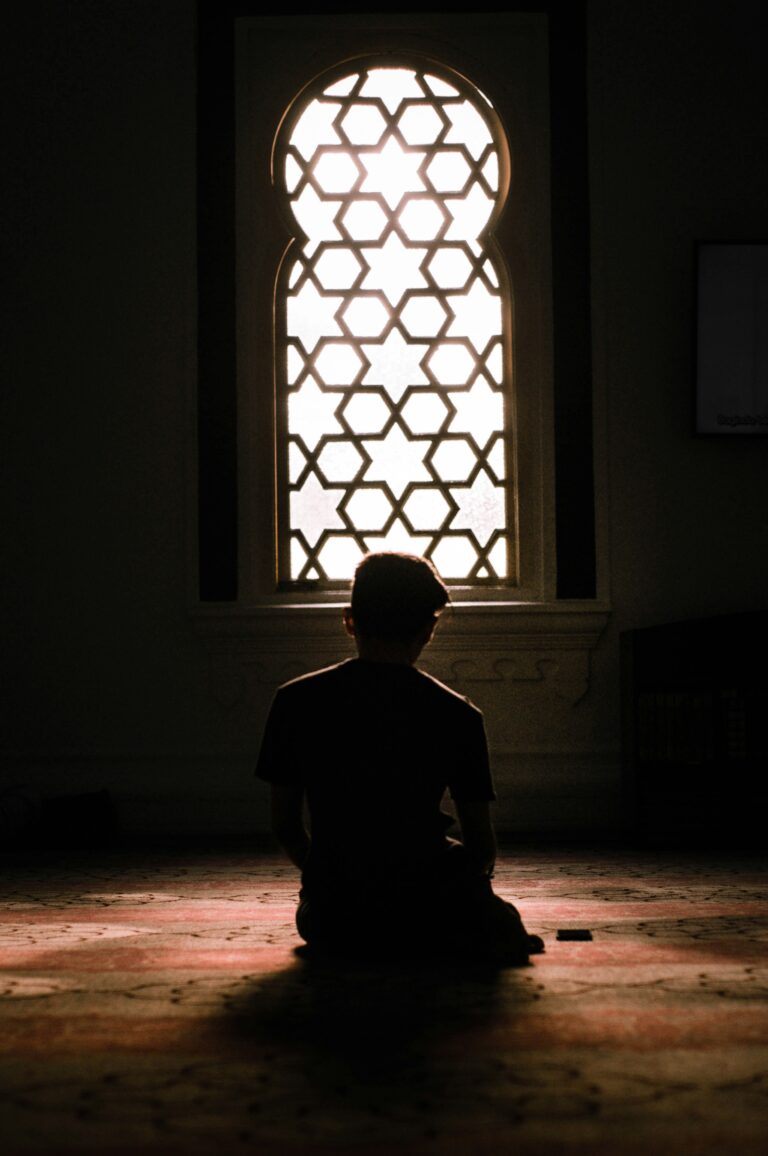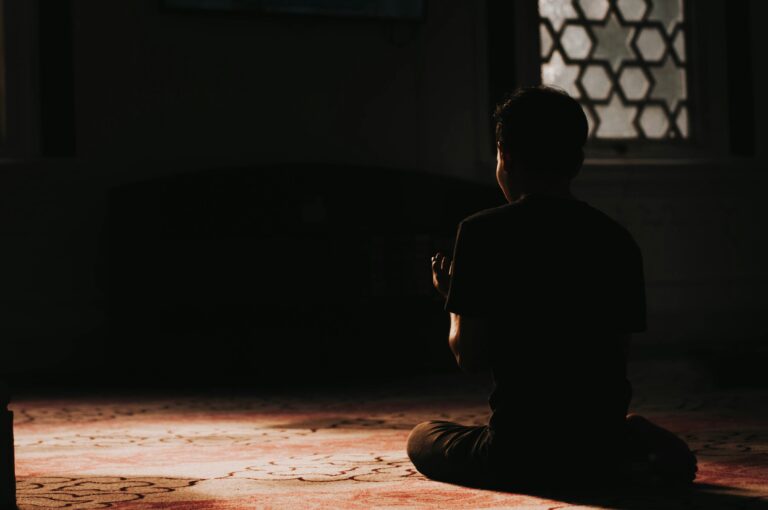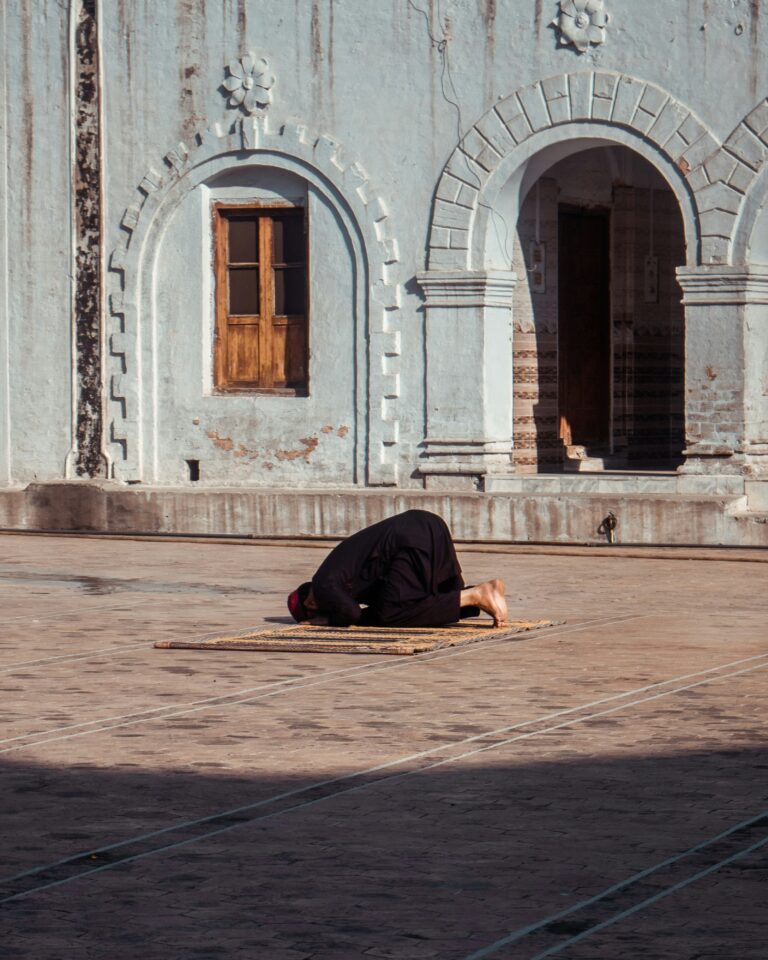


The image of a Muslim in prayer, facing the Kaaba and placing the forehead—the most honoured part of the body—upon the ground, is familiar to Muslims and non-Muslims alike. From the outside, it appears to be one of the highest acts of reverence a person can perform. Yet what Muslims ultimately seek in prayer lies deeper than the outward form. It is a state of stillness, humility, and attentiveness before Allah جل جلاله ;a harmony between the mind, body, and heart. This harmony is closely connected to ihsan, the awareness of worshipping Allah in His presence, and it is embodied in prayer through khushūʿ: humble and attentive devotion.
Muslims pray five times throughout the day, remembering Allah, the Creator جل جلاله, through sacred words and prescribed movements. These words and actions have been preserved and passed down through a continuous chain of transmission of scholars, emulated by the Prophet Muhammad صلى الله عليه وسلم. In Islam, salah is the second pillar of the faith and occupies a central place in Muslim life. Its importance is so great that classical Islamic scholarship has treated the rejection of its obligation as a grave matter of faith.
As Allah جل جلاله says:
وَأَقِمِ ٱلصَّلَوٰةَ لِذِكْرِىٓ
“Establish prayer for My remembrance.”
[Ṭā Hā 20:14]
The purpose of salah is closely tied to dhikr, the remembrance of Allah جل جلاله. Through prayer, the human being is repeatedly returned to their deepest reality: dependence upon Allah جل جلاله, accountability before Him, and the need to live according to His guidance. In this sense, salah is not only a ritual obligation. It is also a spiritual discipline that shapes the believer’s consciousness, softens the heart, and restores the soul to the remembrance of its Creator.
Ṣalāh consists of three interconnected dimensions:
The body participates through standing, bowing, prostration, stillness, and disciplined movement.
The tongue participates through takbīr, recitation of Qur’an, tasbīḥ, tashahhud, duʿāʾ, and salām.
The heart participates through intention, presence, reverence, humility, love, fear, hope, and surrender.
The perfection of ṣalāh requires harmony between these dimensions. If the body moves and the tongue recites while the heart is absent, the prayer loses much of its transformative power.
The inner dimension of ṣalāh may be understood through three ascending levels1:
a. Niyyah – Intention
Niyyah is the basic inner orientation of the act. It directs the prayer toward Allah جل جلاله and distinguishes worship from habit. Through niyyah, the servant consciously begins prayer as an act of obedience and devotion.
b. Ḥuḍūr al-Qalb – Presence of the Heart
Ḥuḍūr al-qalb refers to the heart being present during worship. It is the opposite of heedlessness and distraction. At this level, the worshipper is aware that they are standing before Allah, engaging in a direct act of servitude. For the human heart is liable to be carried away by Satan; so if a person performs many kinds of worship without being present with them, then his limbs are better than his heart. He would therefore be inverted and of an upside-down disposition.
c. Khushūʿ – Reverent Humility
Khushūʿ is the highest level of inward presence attainable in Salah. Ibn Asad defined it as fear arising from the awareness of standing before the Creator. Fear here means what comes over a person of awe, fear, and humility when he becomes conscious that he is standing before the Creator; that he is speaking to Allah directly, and that Allah responds to him in His speech, as alluded in a hadith:
(So when says: “ٱلْحَمْدُ لِلَّهِ رَبِّ ٱلْعَـٰلَمِينَ” [al-Fatihah 1:2], he remembers that Allah answers him by saying: “My servant has praised Me.”
(So when says: “ٱلرَّحْمَـٰنِ ٱلرَّحِيمِ” [al-Fatihah 1:3], he remembers that Allah answers him by saying: “My servant has extolled Me.”
(So when says: “مَـٰلِكِ يَوْمِ ٱلدِّينِ” [al-Fatihah 1:4], he remembers that Allah answers him by saying: “My servant has glorified Me.” In another narration: “My servant has entrusted himself to Me.”
These are for Me, and My servant shall have what he asks.)
In the Islamic tradition, khushūʿ linguistically conveys stillness, lowering oneself, and becoming subdued. This points first to something visible: a quietness and humility that appear upon the body.
In ṣalāh, however, this outward stillness reflects a deeper inward state. Khushūʿ is the humility, attentive reverence, and devotion that bring stillness to the mind, heart, and body before Allah جل جلاله. It is not simply physical calm, but the body’s response to a heart that has become aware of the majesty of the One before whom it stands.
For this reason, Ibn Ḥajar, citing al-Rāzī, explains that khushūʿ may at times refer to an act of the heart, such as fear and awe, and at other times to an act of the body, such as stillness. Its fullest meaning in prayer gathers both: an inward reverence that settles the heart and an outward stillness that reflects it.
As Allah جل جلاله says:
۞ أَلَمْ يَأْنِ لِلَّذِينَ ءَامَنُوٓا۟ أَن تَخْشَعَ قُلُوبُهُمْ لِذِكْرِ ٱللَّهِ وَمَا نَزَلَ مِنَ ٱلْحَقِّ وَلَا يَكُونُوا۟ كَٱلَّذِينَ أُوتُوا۟ ٱلْكِتَـٰبَ مِن قَبْلُ فَطَالَ عَلَيْهِمُ ٱلْأَمَدُ فَقَسَتْ قُلُوبُهُمْ ۖ وَكَثِيرٌۭ مِّنْهُمْ فَـٰسِقُونَ
Has the time not yet come for believers’ hearts to be humbled at the remembrance of Allah and what has been revealed of the truth, and not be like those given the Scripture before—˹those˺ who were spoiled for so long that their hearts became hardened. And many of them are ˹still˺ rebellious.
[Al-Hadid 57:16]
This alludes to the idea that khushūʿ can take on a physical application or an emotional and spiritual meaning.
As an inward experience of the heart that appears upon the body, khushūʿ in ṣalāh revolves around two main dimensions: knowledge and spiritual discipline.
The first is the dimension of knowledge. The worshipper must understand the self and its relationship with the Almighty Creator: where the human being comes from, where he returns, and what is due to Allah جل جلاله. This knowledge gives prayer its meaning. It reminds the servant that he stands in ṣalāh as a created being standing before the One who created him, sustains him, and will return him to account.
The second is the discipline of the heart. This depends upon knowledge, but it also requires practice, struggle, and refinement. The heart is the inner director from which the body takes its direction. When the heart is sound, the body is sound; when it is corrupt, the body follows it into corruption. For this reason, khushūʿ cannot be reduced to outward stillness alone. The limbs may be quiet, but the heart must also be trained to turn toward Allah with humility, attention, and reverence.
This becomes even more serious when we remember that the limbs themselves will bear witness on the Day of Judgment to what a person used to do. The body that bows, prostrates, speaks, looks, and moves is not spiritually neutral. It is shaped by the heart’s orientation and will one day testify to the reality of a person’s actions. A disciplined heart, therefore, gives rise to disciplined limbs, just as an attentive heart gives life to the outward form of prayer.
A general framework may therefore be summarised in three steps: learn the reality and rulings of ṣalāh, practice them earnestly, and continually ask Allah جل جلاله to grant the heart its share of presence, reverence, and acceptance. As the Prophet صلى الله عليه وسلم practised the supplication:
اللَّهُمَّ إِنِّي أَعُوذُ بِكَ مِنْ قَلْبٍ لاَ يَخْشَعُ, وَمِنْ دُعَاءٍ لاَ يُسْمَعُ, وَمِنْ وَنَفْسٍ لاَ تَشْبَعُ, وَمِنْ عِلْمٍ لاَ يَنْفَعُ, أَعُوذُ بِكَ مِنْ هَؤُلاَءِ الأَرْبَعِ
“O Allah, I seek refuge in You from a heart that does not humble itself, from a supplication that is not heard, from a soul that is never satisfied, and from knowledge that does not benefit. I seek refuge in You from these four.”
This teaches us that khushūʿ is both something we strive for and something we beg Allah to place within us.
The Inner Experience of Khushūʿ in Psychological Terms
Psychologically, khushūʿ may be described as a state of focused awareness, meaningful attention, regulated emotion, and embodied submission. It turns the mind away from distraction and toward the reality of standing before Allah. The worshipper is not merely concentrating; they are becoming aware of who they stand before, what they are reciting, and what it means to be a servant in prayer.
Yet khushūʿ is not identical to general mindfulness. In many modern psychological contexts, mindfulness is described as non-judgmental awareness of the present moment. Khushūʿ, however, is a God-directed presence. It is not presence for its own sake, but presence before Allah جل جلاله, shaped by attentive reverence, bodily stillness, and inner tranquility.
Emotion plays a major role in shaping our consciousness and in how the mind directs its attention, memory, interpretation, and motivation. This should not be mistaken for the feeling that arises from it, which is the conscious mental experience of the event5. Rather, emotion often precedes feeling: it begins as a bodily response, sending signals to the mind, which then interprets the event in light of its context and gives rise to a felt experience.
On the one hand, khushūʿ certainly has a strong emotional dimension. It includes awe before Allah’s greatness, fear of His displeasure, hope in His mercy, love for Him, shame over one’s shortcomings, and gratitude for His blessings.
Looking closely at these traits, we find a striking similarity to khashyah and taqwā. Khashyah is deeper than a reactionary fear of what Allah جل جلاله has prohibited; it is a reverent fear grounded in knowledge of Him. Taqwā, likewise, may be understood as a protective restraint upon the nafs, arising from fear and reverence for the sake of Allah جل جلاله within the Islamic tradition.
On the other hand, khushūʿ may also require significant cognitive effort. The worshipper must remember whom they are standing before, understand the meanings of the recitation, resist distraction, renew intention, and interpret the movements of prayer as acts of submission.
This means that khushūʿ is not simply something that “happens” emotionally. It is cultivated through attention, reflection, knowledge, and conscious redirection. The mind plays a central role in preparing the heart to feel reverence.
For example, the heart may not feel awe if the mind is ignorant of Allah’s greatness. The heart may not feel humility if the mind is unaware of its own dependence. The heart may not feel love if the mind does not reflect on Allah’s mercy and generosity.
Therefore, cognition does not oppose emotion in khushūʿ. Human beings are not rational machines, detached from feeling. Rather, sound cognition becomes one of the pathways through which sacred emotion is awakened.
The Relationship Between ʿAql and Qalb
Since earlier scholars described khushūʿ in ṣalāh as something that stems from the heart, a proper understanding of the qalb—the Islamic heart— is essential to this discussion.
In modern language, the mind is often associated with thought and reasoning, while the heart is associated with feeling and moral character. This can be seen even in common expressions. Words and idioms such as “smart,” “witty,” and “clear-headed” point toward intelligence and mental clarity. On the other hand, expressions such as “big-hearted,” “open-hearted,” and “heavy-hearted” point toward compassion, sincerity, sorrow, and inward feeling.
The Islamic understanding of the heart, however, does not completely separate reason from emotion. The qalb is not merely the place of feelings, nor is the intellect merely a cold faculty of calculation. Rather, the heart is a central inward reality through which a person inclines, submits, loves, fears, reflects, and understands.
As Allah جل جلاله says:
فَتَكُونَ لَهُمْ قُلُوبٌۭ يَعْقِلُونََ
“so that they may have hearts by which they reason”
[al-Ḥajj 22:46]
From this verse, many theologians understood the heart as being connected not only to love, fear, and submission, but also to reason and understanding. The ʿaql recognises, reflects, and understands, while the qalb is the inward centre that receives, inclines, and responds.
Some may object that when the brain is damaged, the intellect is also affected. Theologians responded that the brain may function as an instrument through which intellect operates. Therefore, damage to the instrument may affect the expression of intellect without necessarily proving that intellect itself is reducible to the brain.
As Imam Ghazali defines the Islamic heart: a divine, spiritual, subtle entity that has a connection to the physical heart. This subtle entity is the true reality of the human being; it is what knows, perceives, is addressed, and is held accountable.
The mind may recognise a truth while the heart refuses to submit. True benefit to īmān occurs when knowledge moves from information to realisation. A person may know that Allah جل جلاله is great, but khushūʿ begins when that knowledge becomes present and transformative in prayer.
When the mind is attentive and the heart humbled, the body follows: the limbs become still, disciplined, and submissive. Khushūʿ is therefore not confined to one faculty, but is the harmony of mind, heart, and body in worship. When this harmony is absent, the servant returns to supplication, effort, and perseverance.
Modern psychology can help describe aspects of khushūʿ, such as attention, awareness, emotional regulation, and presence. Yet Islam gives these features their ultimate meaning and direction.
Khushūʿ may resemble mindfulness, but it cannot be confined to it. It is a theocentric presence before Allah جل جلاله, shaped by worship, revelation, love, fear, hope, and submission. Rather, it is cultivated through :
Thus, the psychological description of khushūʿ should be tied back to its Islamic foundation: a heart made present before Allah جل جلاله through knowledge, remembrance, humility, and servitude.
The central argument may now be stated clearly: khushūʿ is not purely emotional, nor purely cognitive. It is cultivated through awareness, attention, understanding, reflection, and meaning, yet deepened by emotions shaped through īmān and knowledge of Allah جل جلاله.
Psychologically, this can be seen through cognitive appraisal, where understanding shapes emotion; attention regulation, where the mind is redirected from distraction toward Allah; embodied cognition, where posture and stillness reinforce humility; and emotion regulation, where fear, hope, love, awe, and trust are disciplined by faith.
Khushūʿ is therefore an integrated process: the mind awakens meaning, the heart responds with reverence, and the body expresses submission.
Moving Beyond the False Binary
Separating heart, mind, and body may seem instinctive, but it is too simplistic. Islamic spirituality does not treat them as disconnected faculties. The aim is alignment: the mind understands, the heart submits, and the body obeys.
This is where khushūʿ gives īmān its lived form: not mere information, but knowledge, conviction, feeling, and action.
Khushūʿ as a Commanded Ideal
To seek khushūʿ in ṣalāh is to seek Allah’s pleasure.
As Allah جل جلاله says:
قَدْ أَفْلَحَ ٱلْمُؤْمِنُونَ ١ٱلَّذِينَ هُمْ فِى صَلَاتِهِمْ خَـٰشِعُونَ ٢
“Successful indeed are the believers: those who are humble in their prayer.”
[al-Muʾminūn 23:1–2]
These verses place khushūʿ among the first qualities of the successful believers. It is not a decorative addition to worship, but a central quality of prayer.
Yet the believer recognises human weakness. Perfect khushūʿ is difficult, and many struggle with distraction and inconsistency. The Prophetic principle, faʾtū minhu mā istaṭaʿtum—“do of it what you are able”—reminds the servant to pursue spiritual excellence according to capacity, without abandoning the pursuit.
It is important to distinguish legal validity from spiritual acceptance. A prayer may fulfil its outward legal requirements and count as discharged in this world. This relates to ijzāʾ, the legal sufficiency of the act.
Reward and fuller spiritual acceptance in the Hereafter relate to ithābah, the granting of divine reward. Such matters ultimately belong to the unseen and can only be known through revelation. Still, Islam’s emphasis on khushūʿ indicates that it is a major factor in the prayer’s spiritual weight, reward, and transformative effect.
Therefore, the believer should not be satisfied with merely completing the outward form of prayer. The goal is not simply to “get the prayer done,” but to offer ṣalāh with presence and reverence worthy of the One being worshipped.
Finally, the pursuit of khushūʿ should never be abandoned. Guidance to the straight path of Islam ultimately falls between two ways, ijtibāʾ(Elected guidance) and ihtidāʾ(Received guidance). Some may be granted high levels of presence quickly through Allah’s selection, guidance, and mercy. This is a rare gift that Allah جل جلاله bestows upon the former, whom are called majthub. While the latter may reach it gradually through persistence, struggle, repentance, and repeated effort, for he is called the salik.
The believer, therefore, continues striving, even when distracted, weak, or inconsistent. Each return to prayer is another opportunity to return the heart to Allah جل جلاله. Khushūʿ is not only a state to be achieved, but a lifelong discipline of seeking presence before the Creator.
Khushūʿ is not reducible to emotion, nor can it be explained by cognition alone. It is the harmony of knowledge, awareness, reverence, and submission. The mind recognises the truth of standing before Allah جل جلاله ;the heart becomes humbled by that recognition; and the body follows in obedient stillness. This is the ṣalāh that transforms the believer: a prayer in which the servant is not merely physically present, but inwardly present before the Lord.

Nearest MRT :
Orchard & Somerset
Address:
Al-Falah Mosque
22 Bideford Road #01-01,
Singapore 229923
Contact Number:
+65 6235 3172
Fax:
+65 6735 5580
Email:
[email protected]
Copyright © 2022 Masjid Al-Falah. All Rights Reserved.