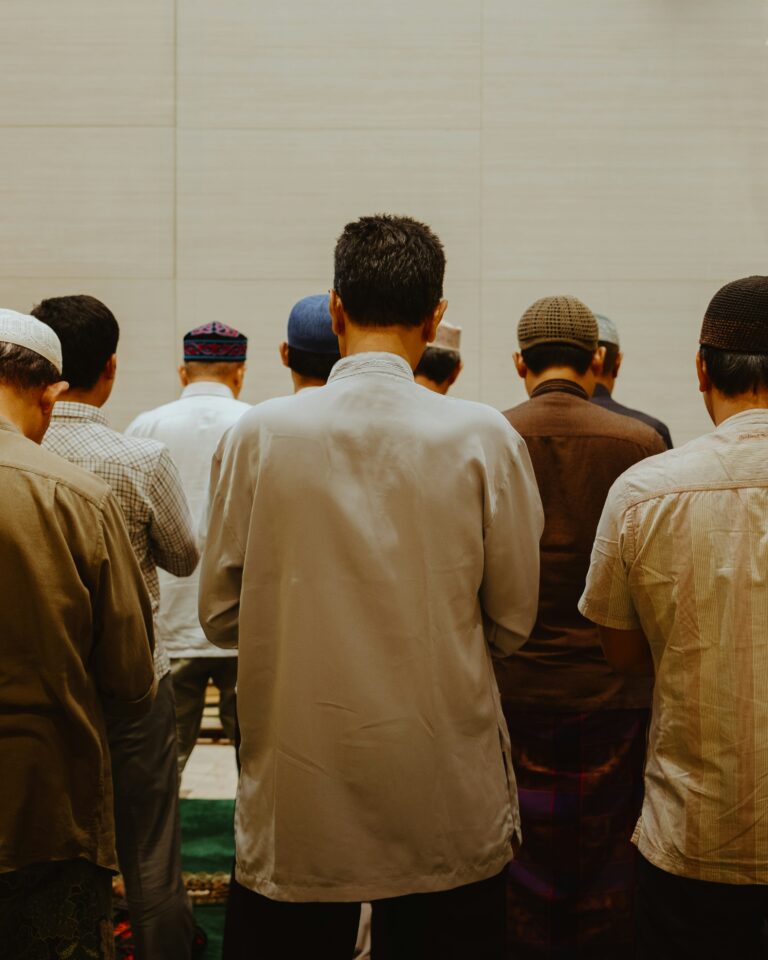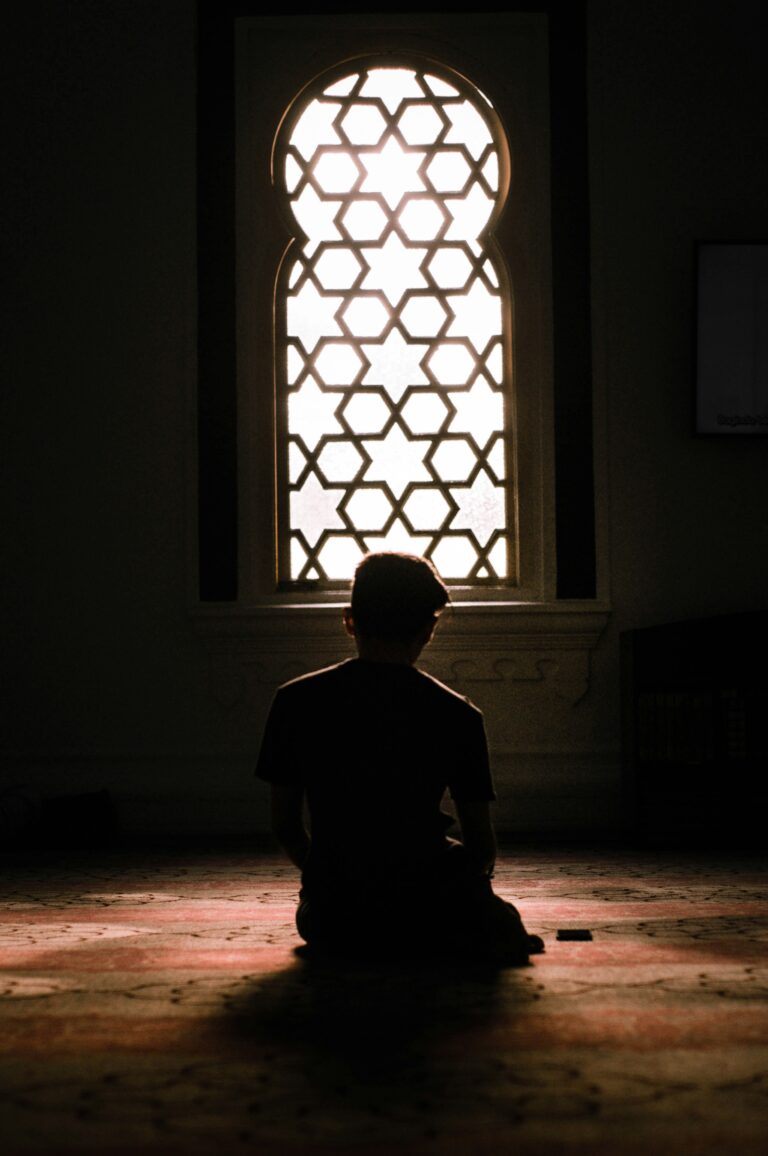

A woven prayer mat is symbolic in the life of a Muslim and in Islamic material culture. If we observe it closer, a woven mat is not made from a single thread. It is woven from hundreds or thousands of threads in a myriad of colours, each crossing another at the right intersection. The mat may still exist if one thread is removed, but it begins to unravel when many are missing. The beauty of the motifs depends not on the prominence of any one thread, but on how each perfectly contributes to the whole.
A Muslim community is like a handwoven prayer mat. In the same way, the ummah is interwoven with people of different cultures, demographics, professions and capabilities. Iman is the warp that holds everything together, while acts of justice, mercy, knowledge and service are the weft that gives the community its strength and beauty. The community becomes a place where people can stand together in worship, just as a prayer mat provides a unified space for meeting Allah (ﷻ). The Prophet (ﷺ) said:
“You see the believers as regards their being merciful among themselves and showing love among themselves and being kind, resembling one body, so that, if any part of the body is not well, then the whole body shares the sleeplessness (insomnia) and fever with it.”
No man is an island. In the thoughts of Ibn Khaldun, he explained that man is created by Allah (ﷻ) as a social being in need of interdependence and collective organisations to fulfil worldly and religious needs. Allah (ﷻ) fashioned man in a form that needs food as a basic sustenance in order to live, and in acquiring food, one requires tools and operations that would render him dependent on others. Likewise, individuals cooperate with fellow beings to seek defence against harm, as the power of an individual cannot withstand that of an animal or a larger group.
Ibn Khaldun argued that humans are created to live together because no individual can survive or flourish alone and that civilisation (‘umran) is a natural condition through which human beings fulfil their material, social, moral and spiritual potentials. He emphasised that civilisation facilitates the worship of Allah (ﷻ) and that social cohesion (‘asabiyyah) is essential in a community, refined with Islam through shared belief. These thoughts complement the idea of ummatan wasatan in the Qur’an (2:143), calling for a community that is just, merciful, balanced and striving for excellence.
In our journey towards ummatan wasatan, Allah (ﷻ) reminds us of the trust (amanah) that is upon us as revealed in the Qur’an:
وَإِذْ قَالَ رَبُّكَ لِلْمَلَـٰٓئِكَةِ إِنِّى جَاعِلٌۭ فِى ٱلْأَرْضِ خَلِيفَةًۭ ۖ قَالُوٓا۟ أَتَجْعَلُ فِيهَا مَن يُفْسِدُ فِيهَا وَيَسْفِكُ ٱلدِّمَآءَ وَنَحْنُ نُسَبِّحُ بِحَمْدِكَ وَنُقَدِّسُ لَكَ ۖ قَالَ إِنِّىٓ أَعْلَمُ مَا لَا تَعْلَمُونَ
“Remember when your Lord said to the angels, “I am going to place a successive human authority on earth.” They asked Allah, “Will You place in it someone who will spread corruption there and shed blood while we glorify Your praises and proclaim Your holiness?” Allah responded, “I know what you do not know.” (Qur’an 2:30)
This revelation not only exemplifies how Allah (ﷻ) has honoured man, among every other creation, as his vicegerent (khalifah) on earth, but it is also foundational in the vision of a just community. Truly every man has the authority and responsibility in this life in the caretaking of His creations and in leading fellow men through the journey in this lower world (dunya) and towards the hereafter. Collectively, one is in need of a cohesive community in order to fulfil the trust of vicegerency and vice versa. The excellence of the Muslim community depends on faith and active moral responsibility of each individual. Both men and women share this collective responsibility in building and sustaining the ummah.
To balance the authority entrusted to man, he is also created a servant (‘abd) to Allah (ﷻ) in which he shall be in servitude and worship, as revealed in the Qur’an:
وَمَا خَلَقْتُ ٱلْجِنَّ وَٱلْإِنسَ إِلَّا لِيَعْبُدُونِ
“I did not create jinn and humans except to worship Me.” (Qur’an 51:56)
In upholding this trust, it is thus also an obligation for man to fulfil the rights of his brothers and be of service to the community as a form of worship to Allah (ﷻ). Communities can only be built upon mutual assistance in goodness, cooperation and justice in serving the weak and maintaining peace. Genuine faith is reflected in concern for society’s vulnerable individuals. Where conflicts arise, individuals in the community are responsible for resolving conflicts and restoring justice and harmony.
If one explores deeper, Al-Attas expounded these concepts by examining the respective root words. He explained that the word deen in Islam has a coherent meaning as reflected in the Arabic language and in the Qur’an, while the concept of religion as understood in English and Western religious history does not carry the same holistic connotations and understanding. The word deen (دِين) in Arabic comes from the root word d-y-n (د ي ن), while the verb dāna (دَانَ) is connected with ‘debt’ and the meaning of ‘being indebted’. Interestingly, among many other words that are derived from the same root, maddana (مَدَّنَ) conveys ‘to build’ or ‘to civilise’. It then relates to another term, tamaddun, which according to Al-Attas, means ‘civilisation’ and ‘refinement in social culture’.
It is therefore apparent that deen and civilisation are conceptually related. The notion of being indebted to Allah (ﷻ) for being in existence then requires mankind to obey His laws and revelations by cooperating mutually through societal life and in building a civilisation of order and justice. Community is the means to living Islam, for it is the very model of life, and the Muslim ummah should strive to be the model community to all mankind.
While some religions promote monasticism, Islam rejects full monastic life and living away from society. The Prophet (ﷺ) was against extreme asceticism and stated that piety includes balance, rest and normal human life, which includes being a part of the community. He performed the roles of a husband, father, leader, governor, judge, teacher, military commander and most importantly, a community member, encompassing the limitless roles that he shouldered as the Prophet (ﷺ) of God. His very participation in the community had earned him the titles of ‘The Truthful’ (Al-Sadiq) and ‘The Trustworthy’ (Al-Amin) before he received the prophethood. It is worth reflecting upon his youth when the Prophet (ﷺ) worked as a shepherd and a merchant, through which he exercised the very qualities expressed by the people in the dealings of daily life. The same qualities and communal life led him to the meeting and marriage with Khadijah (رضي الله عنها).
In the thoughts of Al-Ghazali, he emphasised that communal life is indispensable for spiritual growth, as many acts of worship and ethical obligations are only realised within society. These obligations include worldly and religious goals that would benefit others through service and attain the pleasure of Allah (ﷻ). Communal living also requires one to exercise humility, patience, trustworthiness, empathy, compassion and more, reminding man of his servitude to his Lord and the rest of creation in the way he carries himself and performs various duties.
Evidently, religious responsibility is not purely individual, as Allah (ﷻ) has shown the significance of the community through the ordained communal obligations (fard kifayah). These obligations are placed upon the community collectively: if enough people fulfil them, the obligation is lifted from the rest; if nobody fulfils them, the community as a whole bears the sin. This includes the communal functions of congregational prayer, burial, collective funeral prayer, Islamic judiciary and fatwa, Islamic education, healthcare and so on. These functions of daily necessity again highlight that the communal life is by His design.
Indeed, by His Divine Order, the cosmos was created for diverse communities interdependent of one another:
وَمَا مِن دَآبَّةٍۢ فِى ٱلْأَرْضِ وَلَا طَـٰٓئِرٍۢ يَطِيرُ بِجَنَاحَيْهِ إِلَّآ أُمَمٌ أَمْثَالُكُم ۚ مَّا فَرَّطْنَا فِى ٱلْكِتَـٰبِ مِن شَىْءٍۢ ۚ ثُمَّ إِلَىٰ رَبِّهِمْ يُحْشَرُونَ
“All living beings roaming the earth and winged birds soaring in the sky are communities like yourselves. We have left nothing out of the Record. Then to their Lord they will be gathered all together.” (Qur’an 6:38)
Community in Islam is not simply an obligation or a byproduct of faith; it is the very design and fabric in which Allah (ﷻ) has fashioned the world both tangibly and otherwise. Akin to the ecosystems in which we live, balance and cooperation contribute to a healthy environment for various organisms to thrive, including human beings. Similarly, social harmony through shared belief in Islam is conditional to a just community (ummatan wasatan). It is therefore obligatory for each individual to play their communal roles and fulfil the rights of others. This balance ensures a full circle in maintaining and sustaining the community. Allah (ﷻ) leaves his sign in this play of interdependence in life, for He is the only one who is independent of all creations and needs.
Al-Attas, Syed M. N. Islam: The Concept of Religion and the Foundation of Ethics and Morality. Ta’dib International, 2020.
Al-Bukhari, Muhammad I. I. Sahih al-Bukhari. https://sunnah.com/bukhari
Al-Ghazali, Abu H. Book 1 of the Ihya’ Ulum al-Din. Fons Vitae, 2016.
Al-Ghazali, Abu H. Book 16 of the Ihya’ Ulum al-Din. Fons Vitae, 2023.
Khaldun, Ibn. The Muqaddimah: An Introduction to the History. Translated by Franz Rosenthal. Princeton University Press, 2005.
Khattab, Mustafa. The Clear Quran. https://quran.com/

Nearest MRT :
Orchard & Somerset
Address:
Al-Falah Mosque
22 Bideford Road #01-01,
Singapore 229923
Contact Number:
+65 6235 3172
Fax:
+65 6735 5580
Email:
[email protected]
Copyright © 2022 Masjid Al-Falah. All Rights Reserved.