

بسم الله الرحمن الرحيم
الحمد لله رب العالمين والصلاة والسلام على سيدنا محمد وعلى آله وصحبه أجمعين
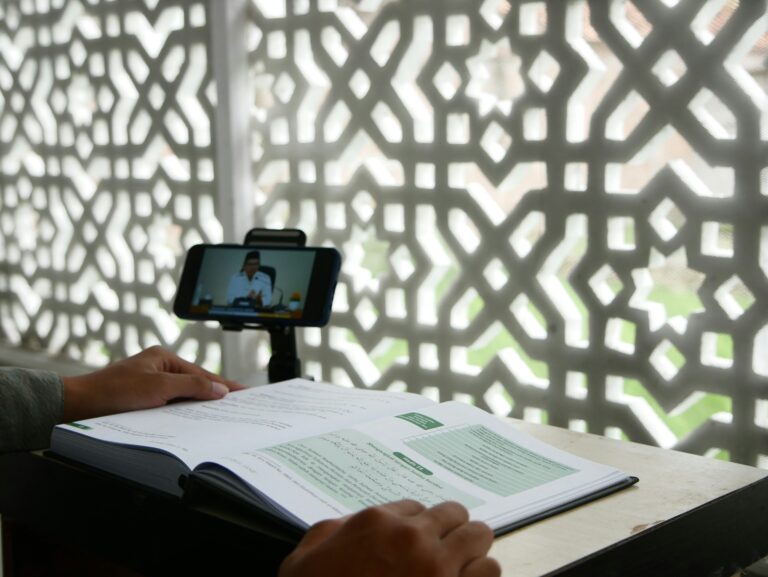
Today, information is everywhere. When there are questions or thoughts that we would like to clarify, everything is accessible through Google or prompts on today’s AI apps such as ChatGPT or Gemini. A person can get what they want to know, access materials or even listen to talks within seconds on their own devices.
Information has become easily accessible, yet despite this convenience, this raises some important questions: what is knowledge in Islam? Is this considered the concept of Islamic Education? Can we merely rely on the internet without authentic teachers?
Scholars differ in defining the reality of ‘ilm (knowledge). There are over fifteen realities of ‘ilm discussed among the Usuliyyin and Mutakallimin such as Imam Abu Hamid al-Ghazali, Imam Fakhr al-Din al-Razi , Imam Jalal al-Din al Mahalli and many more.
Let us take one of the understandings as a base to define knowledge which was written in the Risala of Al-Shafi’i where knowledge is categorised into two which are firstly, doruri which means knowledge that everyone needs to learn and secondly, nazari which refers to communal knowledge where if some members of the community have fulfilled it, the obligation is lifted from the rest.
In al-Umm, knowledge is also understood as following the teachings of our Prophet ﷺ through authentic and reliable sources. Hence, seeking knowledge is not merely gathering information but understanding the deen correctly as how our Prophet ﷺ mentioned in the Hadith “To whomever Allah SWT wills goodness, He grants him understanding of the religion.” narrated by al-Bukhari & al-Muslim
Why do we seek knowledge? In Islam, seeking knowledge is the only route to guide a person out of ignorance towards the truth. The ultimate goal of learning about islam is to bring one to know Allah SWT. Knowledge forms the foundations of worship, character and life as muslim.
In Surah Al-Dhariyat, Allah SWT said: “I did not create jinn and humans except to worship Me.” (51:56) Abdullah ibn al-Abbas (ra) then interpreted “except to worship me” as “except to know me.” This shows that the process of learning which is a form of worship is indeed the process of Ma’rifatullah (knowing Allah Swt). We seek knowledge to understand the reality of Him Allah SWT, to be closer to Him and to fulfill our duty as His servants.
Our Prophet ﷺ mentioned in the Hadith,
“Whoever takes a path upon which to obtain knowledge, Allah makes the path to Paradise easy for him.” (narrated by al-Tirmidzi)
If we are sincere in learning, the path to paradise is open for us. It will bring us happiness in this world and hereafter.
Abdullah Ibn Abbas Radhiyallahu an huma once said: “I humbled myself as a student, so I was elevated and sought after as a teacher.”This shows the importance of adab in seeking knowledge. Adab comes first before we even seek knowledge and knowledge can only be attained through proper etiquettes. This, in turn, equips us with good morals and a way of life that reflects the beautiful character of Rasulullah ﷺ .
In fact, Imam al-Ghazali began writing his great work: The Revival of Religious Sciences with a deep understanding of knowledge, the merits of those seeking knowledge by stating various verses of the Qur’an, Prophetic Narrations and wisdoms from the companions. This indicates the importance of seeking knowledge, the reasons why a muslim needs to seek knowledge and a message to grab the opportunity to transform ourselves into becoming better human beings by seeking knowledge.
Imam al-Baihaqi in his biography work of Imam ash-Shafi’ stated the six foundations of knowledge mentioned in a saying attributed to Imam al-Shafi’i where he once said; “My brother, You will never attain knowledge except for six things:, I will inform You about them in detail: Intelligence, diligence, effort, the necessities, companionship of the teacher, and the passing of time.”
Imam al-Shafi’i proved these six foundations right in his long famous journey of seeking knowledge for years from various teachers at different parts of the world and this shows how He upheld the values of seeking knowledge and later on mastered these sciences well and established the school in Islamic Jurisprudence that became one of the four major schools of thought Muslims follow and practise until today.
Likewise, Imam al-Nawawi in the years of seeking knowledge studied twelve different subjects daily from his teachers and spent years contributing in Islamic knowledge by learning, reading, writing and teaching.
The Moroccan Jurist, Ahmad Zarruq, in his commentary of al-Ghazali’s Principles of The Creed stated that the pillars that help one to attain knowledge are four:
Now that we know there are foundations and pillars to knowledge, our role today is to emulate how our past predecessors laid out the factors needed to attain knowledge.
Knowledge is an amanah from both the teacher and the student. We have to uphold this trust by seeking knowledge from the right sources. Not everything easily found in the internet is considered knowledge; rather, we must always seek clarifications from scholars and teachers who hold on to the etiquettes and integrity of ‘ilm.
Learning about Islam begins from the moment a person realises the importance of seeking knowledge and takes the first step towards it. There is no specific age or time for one to begin seeking knowledge. Although scholars encouraged one to begin in his youth, the door of knowledge opens for everyone throughout their lives.
Imam Abdullah Ibn Alawi Al-Haddad emphasised the importance of seeking knowledge during one’s youth, as how one is shaped with knowledge in their younger days will later reflect how they will remain steadfast upon goodness as they grow.
Therefore, beneficial knowledge will be seen through al-’amal (practise), transformation, retention of knowledge and benefitting others.
Firstly, what we learn we practice. This is affirmed by Imam al-Ghazali who shared a wisdom: “Knowledge without action is madness, and action without knowledge is impossible.” From this wisdom, practice is a sign of beneficial knowledge. For example, one learns the steps to prayers, then practises it in their daily lives. The merits of prayers will reflect back on the teacher who teaches about prayer and his efforts to apply the knowledge gained.
Secondly, knowledge also means transformation. Learning correctly, brings one from a state of darkness to light, from bad to good, from unclear purpose to a clear vision in life. Imam al-Malik said: “Knowledge is a light that Allah places wherever he wills..”
Thirdly, it is only through consistency (al-Istiqamah) one can retain what they have learnt. Retention of knowledge requires one to remember what they have learnt by repeating and revising (al-muzakarah). Al-Hafiz al-Mizzi once said: “Whoever acquires knowledge and revises it, his worldly life and afterlife will be rectified. So remain constant in reviewing knowledge,for the life of knowledge is its revision.”
Lastly, we intend to learn to benefit others. This was also mentioned in the intentions of seeking knowledge by Imam al-Haddad where He wrote, “We intend to seek and spread knowledge. We intend to benefit from knowledge and benefit others.”
We can grow our knowledge by benefitting what we are learning to our close circles such as our family and friends. Even Imam al-Shafi’i once said: “Knowledge is not just about memorising but verily, knowledge is what benefits others.” For example, if we recently learnt about the etiquettes in reciting the al-Qur’an and when it comes the time to read the al-Qur’an with our family, we should share what we’ve learnt with them.
In conclusion, remember that whenever we are learning, we are like sowing the seed and there are great rewards awaiting us.
Allah SWT says,
“Allah will elevate those of you who are faithful, and raise those who seek knowledge in rank. And Allah is All-Aware of what you do.” (58:11)
Amongst it, learning the religion will result in elevation of ranks making one closer to Allah SWT. Just as how a tree needs time to grow, the process of seeking knowledge also takes time and requires perseverance for us to witness the rewards later on.
While information and answers are readily available through social media, this convenience does not replace the proper process of seeking knowledge and may even expose us to unauthenticated or inaccurate information. Seeking knowledge is a noble act that will require us to learn from teachers and scholars. There is no instant process for us to be a learned person except by going through the true process of seeking knowledge.
Alhamdulillah in Singapore, it is a true blessing that our mosques and Asatizah are providing plenty of classes to learn about Islam. We should take this opportunity to attend gatherings of knowledge and tag our loved ones along. Always have this in mind: the more we learn, the more we know that we are in need to learn. Learning is a journey that never ends.
May Allah SWT grant us guidance, istiqamah and sincerity in seeking knowledge.

Nearest MRT :
Orchard & Somerset
Address:
Al-Falah Mosque
22 Bideford Road #01-01,
Singapore 229923
Contact Number:
+65 6235 3172
Fax:
+65 6735 5580
Email:
[email protected]
Copyright © 2022 Masjid Al-Falah. All Rights Reserved.